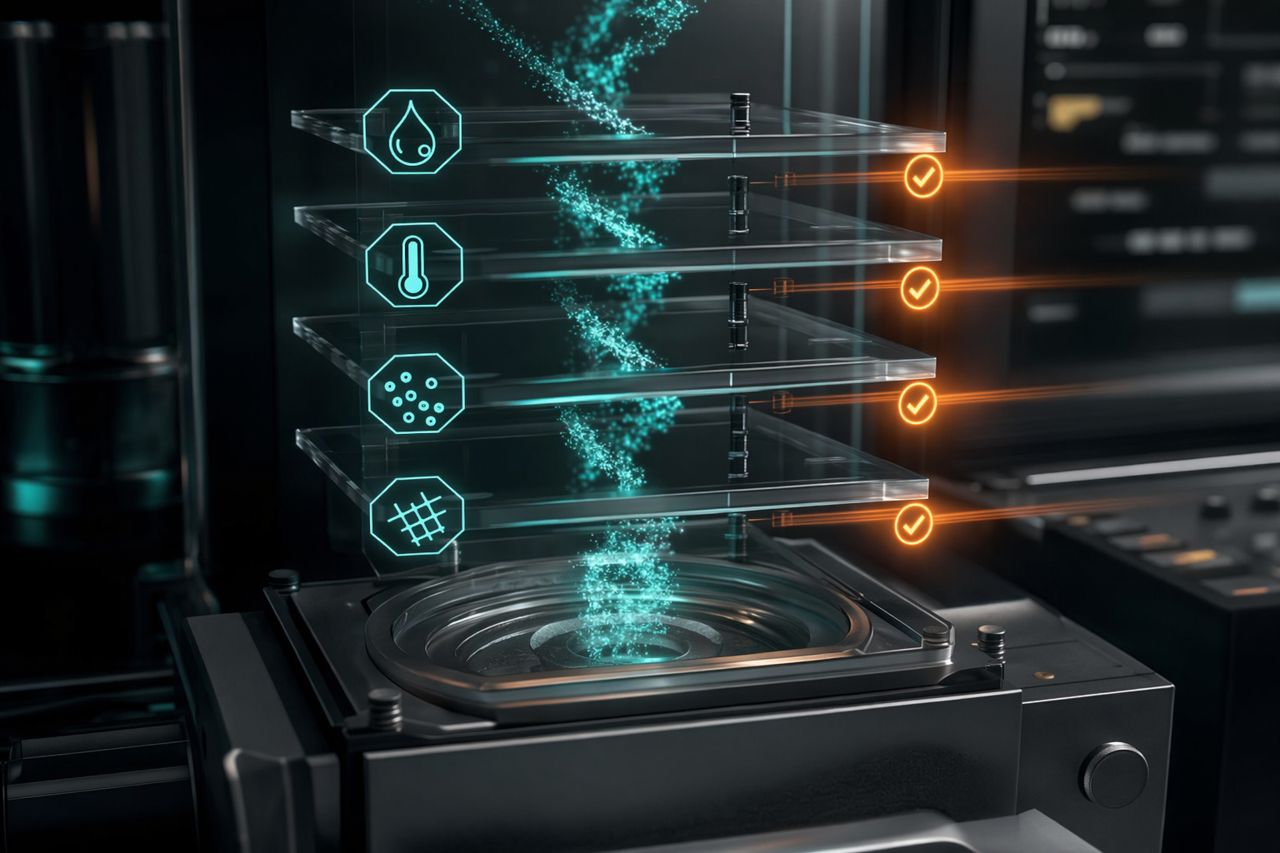
Nuclease Compatibility Factors: pH, Temperature, Salts, and Process Matrix
Evaluate how pH, temperature, salts, chelators, detergents, viscosity, and process matrix conditions affect nuclease fit for DNA and RNA reduction in industrial workflows.
Nuclease compatibility is a process decision, not a single specification
Nuclease is selected to reduce residual DNA and RNA, improve process clarity, lower viscosity, and support cleaner downstream handling. Whether it fits your operation depends on the conditions around the enzyme: pH, temperature, salts, metal ions, detergents, chelators, solids, hold time, and the physical behavior of the process matrix.
For procurement and technical teams, the right question is not simply whether nuclease works. The better question is: will nuclease perform predictably inside your real process window without creating downstream risk?
This guide outlines the main compatibility factors to review before scale-up, supplier qualification, or process transfer.
What nuclease needs to do in the process
Industrial nuclease use is typically driven by one or more operational targets:
Reduce residual host-cell DNA or RNA burden
Decrease viscosity caused by long nucleic acid strands
Improve filtration, clarification, or phase separation behavior
Support downstream chromatography, capture, polishing, or formulation steps
Improve batch consistency where nucleic acid load varies upstream
Reduce fouling risk associated with nucleic acid-rich matrices
Compatibility should be evaluated against those outcomes, not against an isolated lab condition.
pH: protect enzyme performance and downstream fit
pH affects nuclease structure, substrate accessibility, and matrix behavior. It also changes how nucleic acids interact with proteins, cell debris, polymers, and salts.
Practical pH considerations
Near-neutral conditions are often the easiest starting point for broad process compatibility.
Mildly alkaline conditions may improve strand accessibility in some matrices, depending on solids, ionic strength, and protein load.
Acidic conditions can reduce predictability and may increase aggregation or precipitation risk in complex biological mixtures.
Rapid pH shifts can change the matrix faster than the enzyme can act, especially in viscous or high-solids streams.
What to check before implementation
Is nuclease added before or after pH adjustment?
Does the pH window overlap with upstream lysis, extraction, clarification, or hold conditions?
Does the pH condition protect the target product or intermediate?
Are nucleic acids soluble and accessible at that pH?
Will the same pH be used at production scale, or only during bench screening?
Strandfall perspective: the best pH condition is the one that reduces nucleic acid burden while keeping the matrix transferable, filterable, and compatible with the next unit operation.
Temperature: balance kinetics, stability, and process practicality
Temperature influences reaction speed, enzyme stability, viscosity, and microbial control strategy. Higher temperature can accelerate nucleic acid breakdown, but it can also change product stability, impurity behavior, and hold-time risk.
Temperature factors that matter
Cold processes may need longer contact time because molecular movement and strand accessibility are lower.
Moderate temperatures often provide the best process compromise between kinetics and product protection.
Elevated temperatures may accelerate nuclease action but require confirmation that the product, matrix, and downstream steps remain stable.
Temperature uniformity matters at scale. Large vessels, viscous fluids, and high-solids suspensions can create local zones where digestion is slower.
Scale-up questions
Will the vessel reach target temperature before nuclease addition?
Is mixing sufficient to avoid cold pockets or high-viscosity zones?
Does temperature affect foam, precipitation, or membrane loading?
Is the hold time realistic for the plant schedule?
Can the nuclease step run inside an existing process temperature window?
A good nuclease step should fit the manufacturing rhythm rather than forcing a fragile temperature excursion.
Salts and ionic strength: control access, solubility, and downstream behavior
Salts can support or interfere with nuclease performance depending on type, concentration, and matrix composition. Ionic strength also changes how nucleic acids associate with proteins, particles, and surfaces.
Common salt-related effects
Moderate ionic strength can improve matrix handling by reducing nonspecific interactions and improving solubility.
High salt can reduce enzyme-substrate contact or alter the structure of nucleic acid-protein complexes.
Certain ions may support nuclease performance, while others may compete, inhibit, or change the matrix environment.
Salt changes can shift clarification behavior, sometimes improving fluidity but increasing downstream conductivity burden.
Procurement and process review points
Is the nuclease step before or after salt addition?
Does the matrix include phosphate, chloride, sulfate, acetate, or other buffering salts?
Will salt load affect chromatography, membrane steps, or product concentration?
Are salts introduced for extraction, stabilization, or impurity control?
Is desalting or dilution required after nuclease treatment?
Compatibility is strongest when nuclease digestion and downstream conductivity requirements are aligned from the start.
Divalent ions, chelators, and inhibitors
Many nuclease systems depend on metal-ion availability for efficient strand cleavage. At the same time, industrial matrices often contain chelators, reducing agents, detergents, preservatives, or extraction additives.
Conditions that require review
Chelators may reduce available metal ions and lower nuclease effectiveness.
Strong denaturants can compromise enzyme structure.
High detergent levels may improve substrate exposure in some matrices but destabilize enzyme performance in others.
Reducing agents and preservatives should be reviewed for compatibility before production use.
Process carryover from lysis or extraction can create inhibition that is not visible from buffer composition alone.
Recommended evaluation approach
Instead of screening nuclease only in clean buffer, review the actual process matrix after upstream additives are present. This gives a more realistic view of compatibility and helps avoid late-stage surprises.
Process matrix: the real compatibility test
The process matrix controls how nuclease reaches its substrate. A clean buffer condition may show strong enzyme potential, while the real stream may contain barriers: viscosity, solids, lipids, host-cell debris, polymers, product protein, surfactants, nucleoprotein complexes, or shear-sensitive intermediates.
Matrix properties to assess
Viscosity: high viscosity slows mixing and limits enzyme contact.
Solids content: particles can protect nucleic acids or create uneven digestion zones.
Protein load: nucleic acids may bind proteins and become less accessible.
Lipid or membrane debris: hydrophobic material can alter distribution and contact.
Polymers and stabilizers: some can change diffusion, precipitation, or filtration behavior.
Carryover additives: upstream reagents may inhibit or destabilize the enzyme.
Signs that matrix compatibility is good
Viscosity decreases in a controlled and repeatable way
Clarification becomes easier without excessive precipitation
Filtration pressure behavior improves or stabilizes
Downstream steps show fewer nucleic acid-related disturbances
Residual nucleic acid trend is consistent across lots
The nuclease step does not introduce new formulation or purification constraints
Contact time and mixing: where kinetics become operations
Nuclease performance depends on contact between enzyme and nucleic acid. In production, contact is shaped by mixing, transfer time, vessel geometry, fluid viscosity, and addition strategy.
Operational factors
Add nuclease where mixing is reliable, not only where addition is convenient.
Avoid dosing into stagnant zones, foam layers, or highly concentrated slurries.
Consider staged addition for difficult, viscous, or high-load matrices.
Confirm that hold time is compatible with the batch schedule.
Account for temperature and pH equilibration before starting the nuclease step.
A nuclease step that looks efficient at bench scale can underperform if plant mixing does not reproduce the same contact conditions.
Downstream compatibility: digestion is only useful if the next step works better
The nuclease step should reduce downstream burden, not move the problem into another unit operation.
Downstream checks
Does the treated stream clarify faster or with lower pressure rise?
Does reduced viscosity improve transfer, pumping, or filling?
Does conductivity remain within the downstream operating envelope?
Are nucleic acid fragments adequately separated in later steps?
Does the nuclease itself require removal, inactivation, or clearance documentation?
Does the treated matrix protect product quality attributes?
For B2B evaluation, downstream fit is a purchasing criterion. The most valuable nuclease is the one that improves total process control, not only the one that digests strands quickly in isolation.
Compatibility checklist for nuclease qualification
Use this checklist before requesting samples, pricing, or technical review.
Process conditions
Target pH range and actual pH at point of addition
Operating temperature and expected hold time
Salt type and ionic strength category
Presence of chelators, detergents, denaturants, preservatives, or reducing agents
Solids level, viscosity, and mixing constraints
Nucleic acid load variability across lots
Stage of addition: lysis, post-lysis, clarification, pre-capture, or intermediate hold
Performance expectations
Residual DNA/RNA reduction target
Viscosity reduction target
Clarification or filtration improvement goal
Downstream compatibility requirements
Product stability limits
Documentation and lot-to-lot consistency needs
Scale and supply
Batch size and annual demand forecast
Preferred packaging format
Storage and handling requirements
Quality documentation expectations
Change-control sensitivity
Lead time and continuity requirements
How Strandfall supports nuclease evaluation
Strandfall positions nuclease for industrial teams that need predictable nucleic acid reduction under real manufacturing constraints. Our evaluation discussions focus on the operating window, matrix behavior, downstream requirements, and supply continuity.
We can help your team review:
Process condition fit
Matrix compatibility risks
Addition point and hold-time strategy
Documentation needs for supplier qualification
Packaging and supply planning
Commercial pricing for projected demand
Request pricing or compatibility review
Share your process window and procurement requirements. Strandfall will respond with availability, pricing direction, and the next practical step for nuclease evaluation.
Strandfall treats process details as confidential evaluation inputs and uses them only to support fit, pricing, and supply discussion.